Endoscopic Sleeve Gastroplasty and the MERIT Trial
The stitches may hold, but the two-year claim leans on a shrinking group of patients, a touch-up, and a yardstick measured from BMI 25.
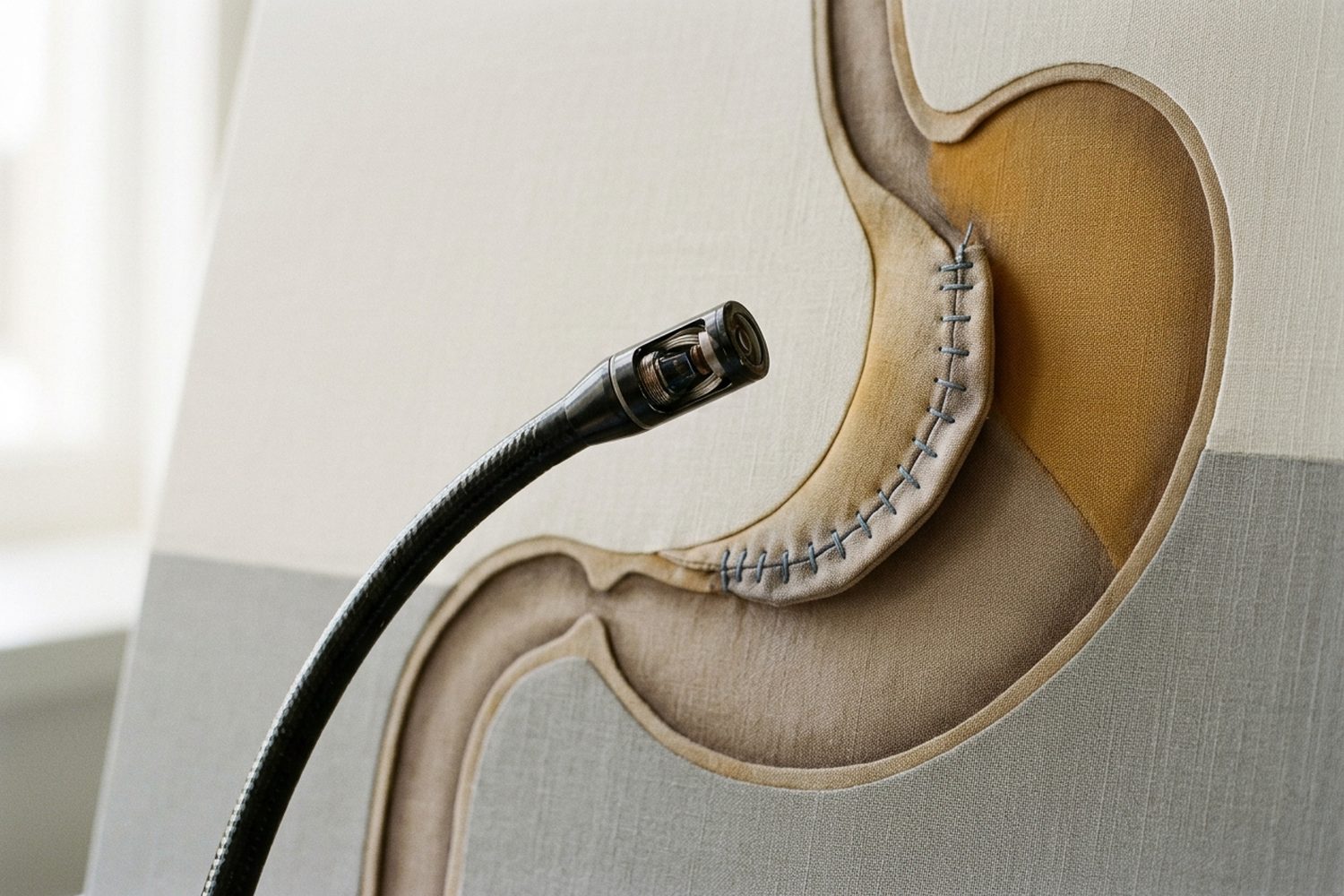
A doctor can now make a stomach smaller without cutting it open. The doctor goes in through the mouth with a flexible scope and sews the stomach’s own wall into a narrower tube. This is endoscopic sleeve gastroplasty, usually shortened to ESG, and its main evidence is a randomized trial called MERIT, published in The Lancet on July 28, 2022. At 52 weeks, people in MERIT who got ESG had lost a mean 13.6% of their total body weight. People in the control group, who got diet and exercise instead, had lost 0.8%.
On whether it lasts: at 104 weeks, 68% of the ESG patients still being counted had kept off at least 25% of their “excess weight.” A separate review says results held up to 3 years. Past that, the facts available here do not settle anything. The phrase “excess weight” is also doing more work than it looks like, and that is most of what this piece is about.
What endoscopic sleeve gastroplasty actually does
Here is the plain version. A gastroenterologist puts a camera down the throat, places stitches in the stomach from the inside, and pulls them tight, so a big stretchy bag becomes a long thin tube. Nothing is removed. A narrative review of ESG describes it as creating a tubular sleeve “without resection, preserving native anatomy.” The whole stomach is still in there. It has just been folded.
Surgical sleeve gastrectomy is different (the site has a separate article on it, and it is the most performed bariatric procedure worldwide). In that operation most of the stomach is cut away and taken out. The surgical version is a demolition. ESG is more like taking in a pair of pants.
So ESG makes the stomach smaller. That is true, but it is not quite the whole story. The more precise and stranger version is that it makes the stomach slower. A MERIT sub-study found that food took much longer to leave the stomach. The half-emptying time was 170.8 minutes at 3 months, against 87.5 for controls, and 133.4 against 87.6 at 12 months. Fasting GLP-1 (the hormone the famous injectable drugs are built to imitate) was up 51% at 12 months, and PYY was up 6.3%. A procedure that looks like tailoring turns out to have some chemistry in it.
How the MERIT trial was set up
MERIT ran at 9 US centers and enrolled people from December 20, 2017 to June 14, 2019. Participants had to be 21 to 65 years old, with a BMI of 30 to under 40, which covers class 1 and class 2 obesity. Anyone with prior gastrointestinal surgery or inflammatory GI disease was excluded. The average participant was 46, 84% were female, and 33% had diabetes at baseline. Funding came from Apollo Endosurgery and Mayo Clinic (two funders who, one assumes, held no particular views about how the stitches would do).
The trial randomized 209 people in a 1:1.5 ratio: 85 to ESG and 124 to lifestyle modification, meaning a low-calorie diet plus physical activity. Then came a twist at 52 weeks. Controls who had not lost enough weight were offered crossover to ESG. ESG patients were offered “retightening” (a word you more usually hear at a tire shop). Hold onto that one.
What the one-year numbers say
The primary endpoint needs translating. Take a person’s current weight. Work out what they would weigh at a BMI of 25. Call the gap “excess.” Then ask what fraction of that gap went away. The official name for this is percentage of excess weight loss, or EWL, and it is the number MERIT was built around.
EWL works the way it would if you measured credit card paydown as a share of the balance instead of in dollars. A person with a small balance who pays $500 looks heroic. A person with a large balance who pays the same $500 looks like they are barely trying. Weight works the same way. Someone at a BMI of 32 has much less “excess” than someone at 39, so losing the same number of pounds produces a bigger EWL. None of this is a trick. It is just arithmetic with a starting line drawn at 25.
The results, anyway. At 52 weeks, mean EWL was 49.2% for ESG (standard deviation 32.0, which is a wide spread) and 3.2% for controls. Of the ESG patients, 59 of 77 (77%) cleared the 25% EWL bar, against 13 of 110 (12%) controls. In plainer units, that is the 13.6% versus 0.8% of total body weight from the top.
On health conditions, 41 of 51 ESG patients (80%) improved on at least one metabolic comorbidity and 6 got worse. Among controls, 28 of 62 (45%) improved and 31 (50%) got worse. The trial’s summary does not say which conditions improved. It reports only the “at least one” figure. And a separate analysis of a national surgical registry, called MBSAQIP, found no clinically meaningful comorbidity improvement in ESG patients at 6 months. The two sources disagree. The facts here do not say which one is right.
On safety, ESG-related serious adverse events hit 3 of 131 participants (2%). There were no deaths, no ICU stays, and no one needed surgery. The MERIT paper calls ESG an “intermediate-intensity intervention.” I feel like that is the most honest phrase in the whole literature. For scale, one network meta-analysis put tirzepatide at about 21.3% total weight loss and surgical sleeve at 21.1%. ESG’s 13.6% sits below both, and other articles on the site do that comparison properly.
The obvious objection: stitches don’t last
Here is what a sensible person thinks. The stomach is a muscular bag designed to stretch. Putting thread in it sounds temporary. Surely the thread loosens, the bag expands, and in a couple of years the patient is right back where they started. That is not a dumb objection. Stomachs are good at stretching.
MERIT’s answer is that 41 of 60 ESG patients (68%) still had at least 25% EWL at 104 weeks, which it describes as “demonstrating 2-year durability.” On the other hand, look at what that sentence actually measures. Randomized to ESG: 85. Counted at one year: 77. Counted at two years: 60. The bar is 25% of the gap to a BMI of 25. And at the one-year mark, ESG patients could get retightened.
So “durable” turns out to mean something stranger than the objection assumed. It does not mean the stitches held perfectly. It means that, of the people still showing up to be weighed, about two-thirds were at least a quarter of the way down from their starting weight to BMI 25, with a touch-up allowed partway through. It is a bit like a golfer reporting a two-year scoring average with one mulligan built into the rules. That is a perfectly legitimate thing to report, if everyone is told about the mulligan.
You can imagine the follow-up visit (this dialogue is invented): “Okay, we’re putting in a few more stitches, and we’ll see you at the two-year weigh-in.” To be fair, the slower stomach and the higher GLP-1 suggest the effect is not purely mechanical, so a loosened stitch is not necessarily the end of the story. Also to be fair, surgery’s long-run numbers are not tidy either. In the SLEEVEPASS trial, surgical sleeve patients were at 43.5% EWL at 10 years.
What is still not settled
The point is that the clock mostly stops at two years. A review pooling ESG studies reports 13 to 16% total weight loss and 35 to 45% EWL at 12 months, with outcomes “sustained up to 3 years.” Beyond that, the facts here are silent. Among endoscopic options, a network meta-analysis ranked ESG highest for 12-month weight loss, ahead of the Spatz3 and Orbera balloons. Another meta-analysis found ESG had much lower odds of new reflux than surgical sleeve, with an odds ratio of 0.08.
Then there is the money. A cost-effectiveness analysis built on MERIT data, taken from the point of view of a US commercial insurer, put ESG at $23,432 per quality-adjusted life year over 5 years. Over longer horizons it found ESG “dominated” lifestyle modification, meaning it came out both cheaper and better. Those longer horizons run past the 104 weeks the trial actually measured, so the model has to assume something about the years in between. That kind of stuff is normal in health economics. It is also exactly where the stitches question lives.
If you are a stomach in the ESG arm and you want to be counted as durable at two years, you had better stay a quarter of the way to BMI 25 and keep coming in to be weighed.
Sources
- Endoscopic sleeve gastroplasty for treatment of class 1 and 2 obesity (MERIT): a prospective, multicentre, randomised trial
- Six-month comparative outcomes of endoscopic sleeve gastroplasty versus laparoscopic sleeve gastrectomy: an MBSAQIP analysis
- Shaping the Future of Restrictive Bariatric Surgery: Clinical, Economic, and Long-Term Perspectives on Endoscopic and Laparoscopic Sleeve
- Multicentre ESG Randomised Interventional Trial - American College of Cardiology
- Randomized Controlled Trial Based US Commercial Payor Cost-Effectiveness Analysis of Endoscopic Sleeve Gastroplasty Versus Lifestyle Modification Alone for Adults With Class I/II Obesity
- Endoscopic Sleeve Gastroplasty: A Qualitative Narrative Review of Outcomes, Safety, and Clinical Applications
- A Comprehensive Review of Sleeve Gastrectomy, Roux-en-Y Gastric Bypass, One-Anastomosis Gastric Bypass, Duodenal Switch, and SADI-S: Very Long-Term Outcomes at 10 Years and Beyond
- Comparison of pharmacotherapies for obesity with sleeve gastrectomy: a network meta-analysis and systematic review
- IBCOx-12 The Endoscopic Sleeve Gastroplasty Produces Durable Physiologic Changes: Results from a Randomized US Clinical Trial
- Comparative effectiveness of balloons, adjustable balloons, and endoscopic sleeve gastroplasty: a network meta-analysis of randomized trials
- Seven-Year Comparative Outcomes of One Anastomosis Gastric Bypass and Roux-en-Y Gastric Bypass for Weight Recurrence Regain Post Sleeve Gastrectomy
- Improvement of Obesity-Related Comorbidities After Bariatric Procedures: A Network Meta-Analysis of Endoscopic Versus Surgical Interventions
Bariatric Alt explains published research. It is not medical advice, and it never recommends a surgeon, a clinic, a dose or a product. Talk to a clinician about which option fits you.