What Is Bariatric Surgery, and How Does It Actually Work?
The stomach gets the credit, but the hormones, bile acids and bacteria downstream may be doing most of the work, and it does not always last.
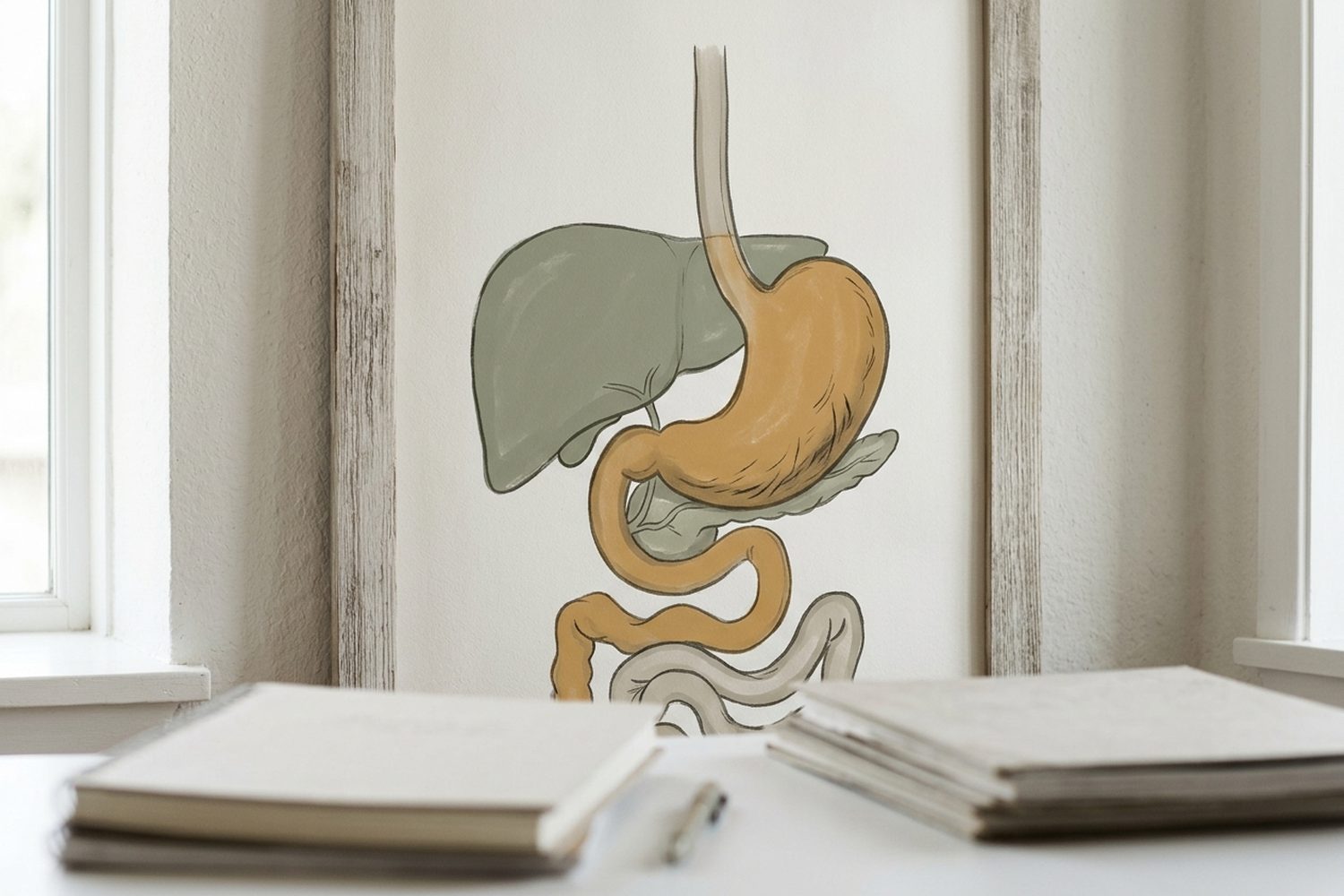
I spent part of this week reading about bile acids, which is not a sentence I expected to write, and it turns out the most interesting thing about weight-loss surgery is how little of it is about the stomach getting smaller. The plain answer to what is bariatric surgery is this. It is a family of operations that change the stomach, the small intestine, or both, so that people with severe obesity lose a large amount of weight and keep much of it off.
The longer answer is that these operations also change how the gut talks to the liver and the pancreas, through hormones, bile acids and gut bacteria, and that much of the metabolic benefit seems to come from that conversation rather than from smaller meals. A review in Clinical Diabetology by Ciesielska and colleagues says the improvement “results from both weight loss-dependent effects and surgery-specific mechanisms that are independent of weight loss.” How the credit splits between those two halves is not settled.
What is bariatric surgery in its simplest version
Start with the reasonable version. Here is an invented surgeon explaining it to an invented patient: “Your stomach holds a lot of food. We’ll make it hold less. You’ll eat less, and you’ll weigh less.” (I made this person up, but I feel like real ones have said something close.) That’s fine. It’s plumbing.
Now escalate one step. Instead of only shrinking the stomach, you also route food past the first stretch of small intestine, so it skips some of the places where it would normally be absorbed. Still plumbing, just more of it. Less goes in, and less of what goes in gets taken up.
One more step. When food arrives lower in the intestine sooner and less digested, the gut releases more of its own hormones (incretins, the family that includes GLP-1) that tell the pancreas to make insulin and tell the brain it has had enough. So now the operation is also, sort of, a drug. It just manufactures the drug inside the patient, on a schedule set by lunch.
One more. The rerouting changes where bile meets food, which changes the bile acids circulating in the blood, and bile acids turn out to be signaling molecules, not just detergent. The gut bacteria shift too. Push this far enough and you reach the absurd endpoint: an operation described as making the stomach smaller that is really an endocrine procedure, where the smaller stomach is mostly packaging. It’s like a home renovation show where the couple knocks out one wall to open up the kitchen and learns the wall was load-bearing and also running the thermostat.
The weird part is how far down that road the literature already is. A focused review on long-term diabetes effects describes the relevant machinery as an intestine, liver and pancreas “axis,” covering adiposity, insulin sensitivity, beta-cell function, incretin hormones, bile acid signaling and gut microbiota. (The intestine and the liver have the sort of relationship that scientists can only describe, delicately, as an axis.) That is six items. A smaller stomach is not on the list.
The procedure families, from smaller stomach to longer detour
The operations line up roughly along that escalation. The sleeve gastrectomy removes much of the stomach and does no rerouting. Roux-en-Y gastric bypass and one-anastomosis gastric bypass make a small stomach and connect it further down the intestine. The duodenal switch (BPD-DS) and SADI-S keep a sleeve-shaped stomach and send food much further along before it meets the digestive juices. (Each of these gets its own article on this site, so I will be brief here, which is hard for me.)
The point is that the longer the detour, the bigger the number. A comprehensive review of very long-term outcomes found that at 10 years, weighted mean total weight loss ranged from 24.4% for the sleeve to approximately 40% for BPD-DS. Those figures pool different patients from different studies, so the ordering is more trustworthy than the decimals. But the ordering is pretty stark.
Hormones, bile acids and the part that is not about portion size
You might assume that sending food on a longer detour means bile acids get lost along the way. A study comparing RYGB with SADI-S found something closer to the opposite. One year after surgery, fasting levels of several conjugated bile acids were significantly higher after SADI-S than after RYGB, and a retention test showed no bile acid malabsorption in the SADI-S patients and normal retention in 90.6% of the RYGB patients. So the body keeps its bile acids and runs more of them through the blood. What exactly the extra bile acids are doing for weight and glucose is, on these facts, not settled.
Bile has a less glamorous side, which is gallstones. In a retrospective cohort of 1,163 patients (377 bypass, 786 sleeve) followed for a mean of 34 months, 8.3% developed symptomatic gallstones, with no significant difference between the two operations. Women had about 2.3 times the risk of men.
And patients who were given ursodeoxycholic acid, which is itself a bile acid, had a hazard ratio for gallstones of 0.13, with a 95% confidence interval of 0.01 to 0.99. Look at that upper bound. A hazard ratio of 1 means no effect at all, and this interval stops one hundredth short of it. The data are consistent with the drug cutting the risk by 99%, and also consistent with it cutting the risk by 1%, and the whole thing clears the bar for significance by the width of a rounding error. I find it kind of beautiful. (It is also an association in a retrospective study, which is a different thing from a trial.)
How far the real world has gotten
If the operation were only about eating less, you would expect diabetes to improve slowly, in step with the scale. That is not quite what the big cohorts show. In one electronic records study of 8,012 bariatric patients operated on between 2013 and 2026, 2,197 had type 2 diabetes beforehand, and 2,056 of them (93.6%) went at least 90 days without any diabetes medication after surgery. A Malaysian cohort of 1,478 patients found 80.9% of diabetic patients had an HbA1c below 6.5% one year out.
Between us, a 90-day medication-free stretch is a lower bar than “cured,” and I suspect the study’s authors agree, because they went on to count what happened next. Before that, though, one line on drugs, since other articles here handle the comparison: a 2026 systematic review found surgery produced diabetes remission in 23% to 70% of patients against 0% with incretin-based drugs, and five-year weight loss of 25% to 32% against 14.9% to 20.9% with semaglutide or tirzepatide. Those drugs imitate one of the hormones the operation turns up. The operation turns up several, plus bile acids, plus the bacteria stuff.
The part that wears off, or doesn’t
Here is what happened next. Of the patients who reached that medication-free interval, 882 (42.9%) later went back on diabetes medication, with a median time to restarting of 1.04 years. Bypass patients were less likely to restart than sleeve patients (hazard ratio 0.778). Longer diabetes duration, higher baseline HbA1c and preoperative insulin use all predicted restarting, with insulin use the biggest of the three (hazard ratio 1.627).
There are two ways to read this. One is that the hormonal effect of the operation fades, and the plumbing eventually reasserts itself as merely plumbing. The other is that the operation never repaired the pancreas at all, and simply bought time against a disease that kept going in the background, so the people who relapsed were the ones with the least time left to buy. The Clinical Diabetology review says long-term outcomes “depend largely on disease severity and residual β-cell function,” which fits both readings, I suppose. The facts here do not pick one.
And for 5% to 8% of patients, the first operation does not produce an adequate response, and they go on to revisional surgery. A review in Frontiers notes that revision and conversion are associated with “higher morbidity and mortality compared to the primary surgical intervention.” So the second try costs more than the first, or whatever the surgical version of interest is.
My own expertise in the gut, before this week, consisted of knowing roughly where lunch goes. Having now read about axes and conjugated bile acids, I can report that the operation built around persuading the pancreas works best on people whose pancreas still needs the least persuading.
Sources
- Long-Term Effects of Bariatric Surgery on Type 2 Diabetes: Mechanisms, Outcomes, and Clinical Implications: A Focused Review
- A Comprehensive Review of Sleeve Gastrectomy, Roux-en-Y Gastric Bypass, One-Anastomosis Gastric Bypass, Duodenal Switch, and SADI-S: Very Long-Term Outcomes at 10 Years and Beyond
- Incidence of Symptomatic Cholelithiasis Following Laparoscopic Roux-en-Y Gastric Bypass Is Comparable to Laparoscopic Sleeve Gastrectomy: A Cohort Study
- Bariatric Surgery and Type 2 Diabetes Remission and Relapse: Mechanisms, Predictive Factors, and Postoperative Management — a Review Article | Ciesielska | Clinical Diabetology
- Laparoscopic Single Anastomosis Duodeno-Ileal Bypass Versus One Anastomosis Gastric Bypass as Revisional Procedures after Sleeve Gastrectomy: Meta-analysis and Systematic Review
- Frontiers | Endoscopic Management of Weight Recurrence Following Bariatric Surgery
- Baseline Diabetes Severity Is the Dominant Predictor of Diabetes Medication Re-Initiation Following Bariatric Surgery
- Incretin-Based Therapies Versus Bariatric and Metabolic Surgery for Obesity and Type 2 Diabetes Mellitus: A Head-to-Head Systematic Review of Glycaemic, Cardiovascular, Hepatic, Weight, and Quality-of-Life Outcomes
- Long-Term Weight Loss and Metabolic Outcomes After Bariatric Surgery in a Large Asian Cohort: A Real-World Cohort Study
- Changes in Bile Acid Metabolism and Nutrient-Stimulated Hormone Responses After Malabsorptive Metabolic Surgery: RYGB Versus SADI-S
Bariatric Alt explains published research. It is not medical advice, and it never recommends a surgeon, a clinic, a dose or a product. Talk to a clinician about which option fits you.