Whatever Happened to the Lap-Band?
The band could always be taken out, and the long-term data suggest that is exactly what happened, with some caveats about who was counted.
In a Polish study that followed weight-loss surgery patients for ten years, the share of adjustable gastric band patients who needed another operation was 100%. Not most of them. All of them, or at least all of the ones the researchers could still find (which, as we will see, is doing a lot of work).
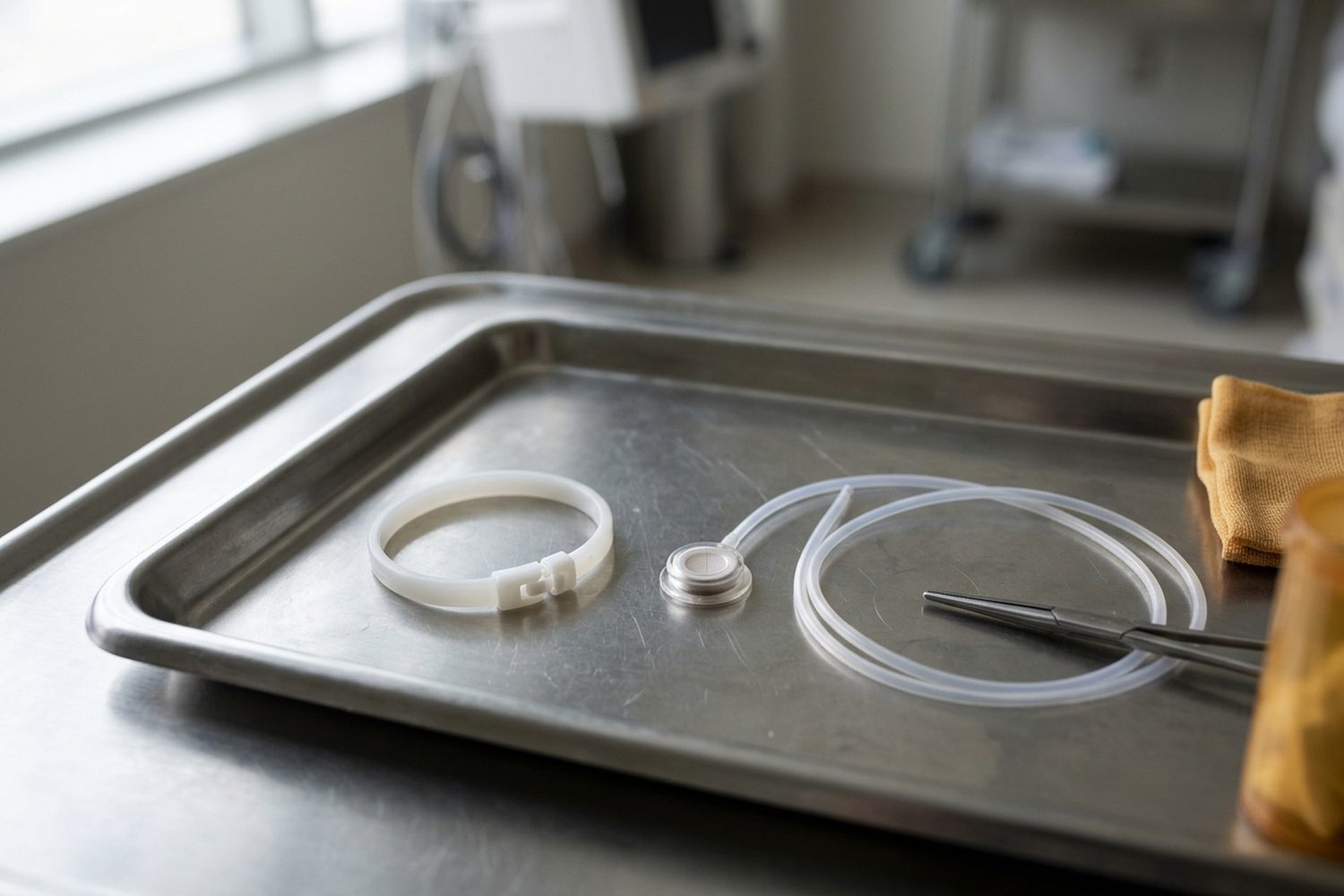
That is, more or less, what happened to the lap band. It was the gentle option: a ring around the top of the stomach, nothing cut or rerouted, adjustable after the fact and removable if things went badly. The long-term studies say it did much less for diabetes than gastric bypass, and that it came back out, or got turned into some other operation, so often that in one study it happened every single time. Why it fell is partly settled and partly not, and the unsettled part is the interesting part.
How an adjustable band was supposed to work
The pitch for the band was sort of the pitch for any reversible thing. A gastric bypass rearranges the plumbing, and a sleeve removes most of the stomach (permanently, with no undo button). The band just sat there, a collar around the upper stomach, and a clinician could tighten or loosen it later through a small port. If it didn’t suit you, it came out.
Everyone involved had a sensible reason to like this. A patient facing major surgery was offered something that sounded less final. A surgeon got an operation with less to go wrong on the table. Anyone nervous about permanent anatomy got an off switch. The only open question was whether a collar could do what a rerouting does.
What the lap band did for diabetes, in numbers
The cleanest comparison in the evidence comes from the Longitudinal Assessment of Bariatric Surgery, or LABS. After gastric bypass, diabetes remission was 71.2% at one year, 69.4% at three, 64.6% at five and 60.2% at seven. After the band it was 30.7% at one year, 29.3% at three, 29.2% at five and 20.3% at seven.
So the band started at less than half the bypass rate and then lost about a third of that by year seven. (The seven-year confidence interval runs from 9.7% to 30.9%, which is less a measurement than a shrug.) The sources here do not give a band weight-loss figure to set beside the roughly 20% to 30% total body weight loss attributed to the sleeve, so I am not going to invent one.
To be clear, the bypass fades too. A Geisinger study of 2,045 bypass patients found diabetes remission of 54% at three years falling to 38% at fifteen. Fading is the normal condition of this field. The band just faded from a lower starting point, against a competitor that was also fading, and it still lost.
Then there is the Polish study, BARI-10-POL. Its authors reported that “revisional bariatric procedures were required in 23.9% of patients over 10 years, most commonly after sleeve gastrectomy (24.3%) and adjustable gastric banding (100%).” That parenthetical is the most efficient obituary in the bariatric literature.
There are, roughly, three ways to read this
The band’s decline can be explained three ways, and they get less comfortable as they go. They are not exclusive. You can believe all three at once, and a lot of people in the field sort of do.
Reading one: it just did less
The first reading is the boring one. The band limited how much food fit in at once, and that was about it. The bypass changes the route food takes, and a study measuring bile acids and gut hormones after bypass found a whole cascade of changes after a meal. The diabetes numbers above look like the difference between doing one thing and doing several. On this reading the band didn’t fail so much as lose a fair fight.
That’s fine as far as it goes. It doesn’t explain the 100%, though. A weaker operation could just stay weaker forever, quietly.
Reading two: adjustable means somebody keeps adjusting it
The second reading is about maintenance. The band’s best feature was that it could be changed after surgery, and a thing that can be changed will be. Every tightening is a visit. Every problem is a decision about whether to keep the device. A ring with an off switch invites the question of when to use the switch.
Think of the cheap home printer, for instance. The printer was never the product; the ink was. An operation that only places a ring, and then needs the ring adjusted, and then needs it removed and replaced with a sleeve or a bypass, has turned one modest operation into two or three. It must be a real hardship for the surgeons who get to perform the second one.
Here is an invented version of the consult. “The nice thing about the band,” a surgeon says, accurately, “is that we can always take it out.” (Invented, but it is the band’s entire sales pitch in one line.) Years later, they take it out.
On the other hand, there is a second way to read the 100% itself. BARI-10-POL had a ten-year follow-up rate of 28.5% (485 of 1,703 patients), and the sources here don’t say how many band patients were among the 485. The people still showing up at a surgical study after a decade are plausibly the people who still have a reason to see a surgeon. A band patient who is doing fine might just not answer the letter. So 100% might mean every band failed, or it might mean every band patient still in touch had a band that failed. The data do not tell those apart.
Reading three: reversible means it gets reversed
The third reading matters for everything else on this site. Maybe the band wasn’t a strange failure. Maybe it was the first option honest enough to fail on schedule, because undoing it was the design.
Look at its neighbors. In the same Polish study the sleeve had a 24.3% revision rate. A ten-year meta-analysis found the sleeve carried a markedly higher rate of conversion to bypass than starting with a bypass. In the SLEEVEPASS trial, ten-year reoperation was 15.7% after sleeve and 18.5% after bypass, with no significant difference. Nothing here is a one-time event. Some things are just closer to it.
The balloon is the band’s purest descendant: placed, removed, done. A narrative review titled “GLP-1 medications versus surgery and balloon: evaluating cost-benefit in weight loss” put balloon weight loss at roughly 10% to 15%, with “typically temporary results after removal.” A network meta-analysis of randomized trials found the FDA-approved endoscopic therapies beat control at the moment of balloon removal, which is a precise way of saying they work while they are in. The same review puts GLP-1 drugs at roughly 10% to 15% too, and a drug is the most adjustable device of all (other articles here handle that comparison properly).
And the ring never quite died. Some bypasses are done with a ring added around the pouch. A meta-analysis of randomized trials found overall complications similar to standard bypass, plus a “preliminary signal of higher re-operation rate” with the ring. To be fair, the authors also say the required information size had not been reached, so that one is not settled.
Now push the band’s logic all the way. Imagine (this clinic is entirely made up) a practice where everything is reversible: a band you can loosen, a balloon you can retrieve, a ring you can remove, each one followed by the next. Its revision rate is 100%. Its patient retention is also 100%. Its annual report calls this “lifelong engagement,” and I guess technically it is.
You and I both know how this goes with anything that ships with a cancel button. Anyway, the point is not that reversibility is bad stuff. It is that reversibility was the product, and the product got used.
The band was the operation you could undo. So people undid it.
Sources
- Long-term outcomes of metabolic bariatric surgery: a 10-Year multicenter retrospective study in Poland (BARI-10-POL)
- Roux-en-Y gastric bypass results in long-term durable weight loss and diabetes remission: a single center, > 15 year outcomes
- New Study Shows Long-term Effectiveness of Gastric Bypass in Treating Type 2 Diabetes and Obesity - American Society for Metabolic and Bariatric Surgery
- GLP-1 medications versus surgery and balloon: evaluating cost-benefit in weight loss
- Ring-Augmented Versus Standard Roux-en-Y Gastric Bypass: A Systematic Review and Meta-Analysis of Randomized Controlled Trials with GRADE Assessment
- Ten-Year Follow-Up for Sleeve Gastrectomy Versus Roux-en-Y Gastric Bypass: A Systematic Review and Meta-Analysis
- Seven-Year Weight Trajectories and Health Outcomes in the Longitudinal Assessment of Bariatric Surgery (LABS) Study
- Effect of Laparoscopic Sleeve Gastrectomy vs Roux-en-Y Gastric Bypass on Weight Loss, Comorbidities, and Reflux at 10 Years in Adult Patients With Obesity: The SLEEVEPASS Randomized Clinical Trial
- Changes in Bile Acid Metabolism and Nutrient-Stimulated Hormone Responses After Malabsorptive Metabolic Surgery: RYGB Versus SADI-S
- Comparative effectiveness of balloons, adjustable balloons, and endoscopic sleeve gastroplasty: a network meta-analysis of randomized trials
Bariatric Alt explains published research. It is not medical advice, and it never recommends a surgeon, a clinic, a dose or a product. Talk to a clinician about which option fits you.